
You finish the job.
Now comes the second job.
Update the customer. Add the extra work to the invoice. Send it. Check tomorrow's schedule. Make sure Mike is assigned to the morning job. Follow up with the customer who still hasn't paid.
For years, small business owners have been told the solution is to delegate.
And technically, that's good advice.
But traditional delegation comes with its own workload.
Write the process. Explain the task. Send the information. Answer the follow-up questions. Check the work. Correct the mistakes. Follow up again.
At some point, you have to ask:
If delegating the admin creates more admin, how much have you actually handed off?
That's where AI has the potential to fundamentally change how small businesses operate.
The next generation of business software shouldn't just help you organize your administrative work.
It should be able to take the handoff and do the work.
What Does It Actually Mean to Delegate Admin?
Delegating admin should mean handing off the task, not just finding a faster way to do it yourself.
Traditional software might turn a 15-minute task into five minutes. That's useful—but it's still your five minutes.
True delegation looks more like this:
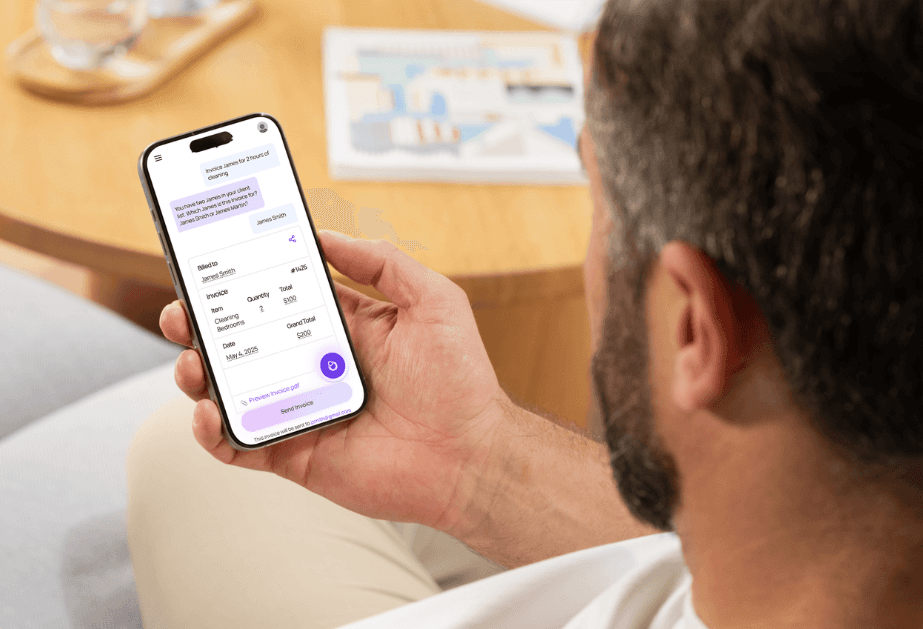
“Invoice Sarah $1,800 for the patio installation and add $250 for the extra stone.”
And the task gets done.
You shouldn't have to translate a simple request into twelve clicks across four screens. And you shouldn't need to build an SOP for routine work like sending an invoice, updating a customer, or moving a job on the schedule.
AI should make the handoff simpler, not give you another process to manage.
A Better Small Business Handoff Checklist
Before documenting another workflow, ask:
Can I just say what I need done? Your software should understand an instruction much like an employee would.
Does it already have the context? Customer details, estimates, jobs, schedules, invoices, and payments shouldn't need to be re-entered.
Can it finish the task? Generating an invoice description isn't the same as creating and sending the invoice.
Does it know when it needs me? Good delegation keeps you in control when judgment or approval actually matters.
That's the shift from AI assistance to AI delegation.
AI that writes something for you to copy, paste, enter, and send may save a few minutes. AI that understands the outcome and completes the workflow can actually take work off your plate.
What Should You Delegate to AI?
Start with necessary, repetitive work that doesn't need your expertise every time: estimates, routine scheduling, crew assignments, invoices, payment tracking, customer records, and follow-ups.
Keep yourself involved where your judgment matters: unusual pricing, complicated jobs, important customer conversations, or decisions about your team.
The goal isn't to remove you from your business.
It's to remove you from the work that doesn't need you.
That's the idea behind Invoyce. Instead of learning another software workflow, you can say:
“Move the Smith job to Thursday and put Mike and Chris on it.”
Or:
“Which invoices are overdue?”
Or:
“Invoice the Johnsons $2,400 for the patio repair and add $300 for the drainage work.”
You already know how to delegate. Your software should know how to take the handoff.
Frequently Asked Questions
What admin task should I delegate first?
Start with frequent, structured tasks that steal time without requiring much judgment: creating estimates, sending invoices, updating customer information, checking payment status, following up on overdue invoices, or managing routine scheduling.
Can I delegate admin without hiring an employee?
Increasingly, yes. AI-powered business tools can complete administrative tasks that previously required either the owner or another person to handle them manually. The important distinction is whether the software actually completes the task or simply gives you another tool for doing it yourself.
What's the difference between automating and delegating admin?
Automation usually follows a predefined rule: when X happens, do Y.
Delegation starts with an outcome: here's what I need done.
AI is beginning to make the second model possible for small businesses because software can understand natural-language instructions, use existing business context, and take action.
Will AI replace an office manager?
Not entirely. Human employees can handle nuanced customer conversations, make judgment calls, solve unusual problems, and take responsibility across areas that software may not be equipped to manage.
But many repetitive administrative tasks that once consumed an owner's time — or contributed to the need for additional administrative staff — can increasingly be handled by software.
And that changes the economics of running a small business.

More Operations